SkaiLab
Finding, assessing, and onboarding employees with AI
HR is traditionally considered one of the most labor-intensive functions because of the huge volume of communication and paperwork. The cost of a mistake is also critical: a bad hire can cost a company several years of the employee’s salary.
Artificial intelligence can dramatically accelerate the hiring funnel by taking over routine screening of hundreds of resumes and initial candidate qualification.
But AI’s capabilities extend beyond recruiting. The technology helps build a seamless onboarding process by providing new hires with personal assistants ready to answer any question 24/7.
This allows HR managers to stop acting as an information desk and focus on developing company culture and strategy.
Using AI in HR is a way to make work with people more human, freeing time from endless paperwork and standard tasks for meaningful talent development within the organization.
HR is one of a company’s most labor-intensive functions. Recruiting, onboarding, employee assessment, and HR analytics all require enormous amounts of manual work. The cost of mistakes is high: a bad hire costs the company 3–6 months of the candidate’s salary. AI makes it possible to accelerate processes and improve their quality.
Key areas for automation in sales
- Automatic resume screening and initial candidate qualification
- Writing job postings and adapting them to different platforms
- Automating communication with candidates
- Analyzing cultural fit and values
- Automating new employee onboarding
- HR analytics and employee turnover forecasting
- 360-degree feedback and assessment
- Automating HR document workflows
CASE 3.1 Automatic resume screening
The challenge: When a position opens, an HR specialist receives 50–200 resumes. Reviewing each one
takes 3–5 minutes: a total of 3–15 hours for initial screening of a single vacancy. With several
positions open at once, the process becomes overwhelmed.
The AI solution: An AI agent receives the job description and automatically analyzes
incoming resumes against defined criteria: experience, skills, education, and location. Each
candidate receives a match score with an explanation. HR sees a ranked list with
brief summaries for each candidate. Irrelevant resumes are filtered out automatically.
Expected result: Initial screening time drops from 15 hours to 30 minutes. HR
works only with relevant candidates. Vacancies are filled 40–60% faster.
Implementation complexity: ⭐⭐ Low (1–2 days of setup)
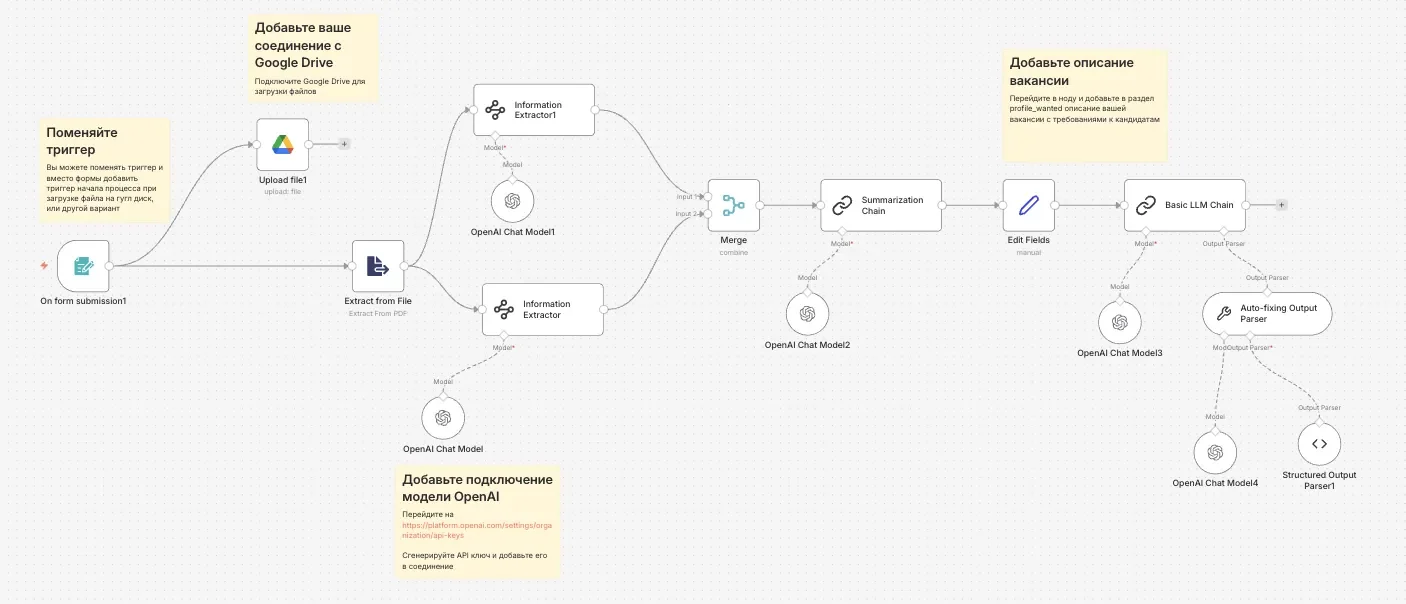
How the process works: Resumes arrive by email or form as PDF/DOCX files → files are parsed and text
is extracted → the AI agent compares the content with the job description against defined criteria: experience,
skills, location, and education → each candidate receives a match score with a brief
explanation → the result is a ranked list in Google Sheets.
Core components: Email Trigger / Webhook → File Parser (Extract from PDF) → AI Agent (scoring +
explanation) → Google Sheets
Download the ready-made workflow
💡 Want to try it on your own vacancies?
Contact us by email and we will tailor the screening criteria to your candidate profile.
CASE 3.2 AI assistant for onboarding new employees
The challenge: A new employee’s first 30–90 days determine whether they will stay with the company. But HR
often lacks the time to provide enough onboarding support: there is no structure, answers to questions
take too long, and important information is passed on verbally and lost.
The AI solution: An AI assistant is built on the company’s internal knowledge base
of policies, FAQs, organizational structure, and processes. New employees receive access to a Telegram
or Slack bot that answers any question, from ‘Where is the restroom?’ to ‘How do I get a business trip
approved?’ At the same time, tasks for the first week, first month,
and first 90 days are assigned automatically. If the knowledge base has no answer to a question, a message is sent
to the HR manager.
Expected result: Onboarding time drops from 2–3 months to 3–4 weeks. The workload on
HR and line managers falls. New employee satisfaction rises, and turnover
during the first 6 months decreases by 20–30%.
Implementation complexity: ⭐⭐⭐ Medium (requires a structured knowledge base)
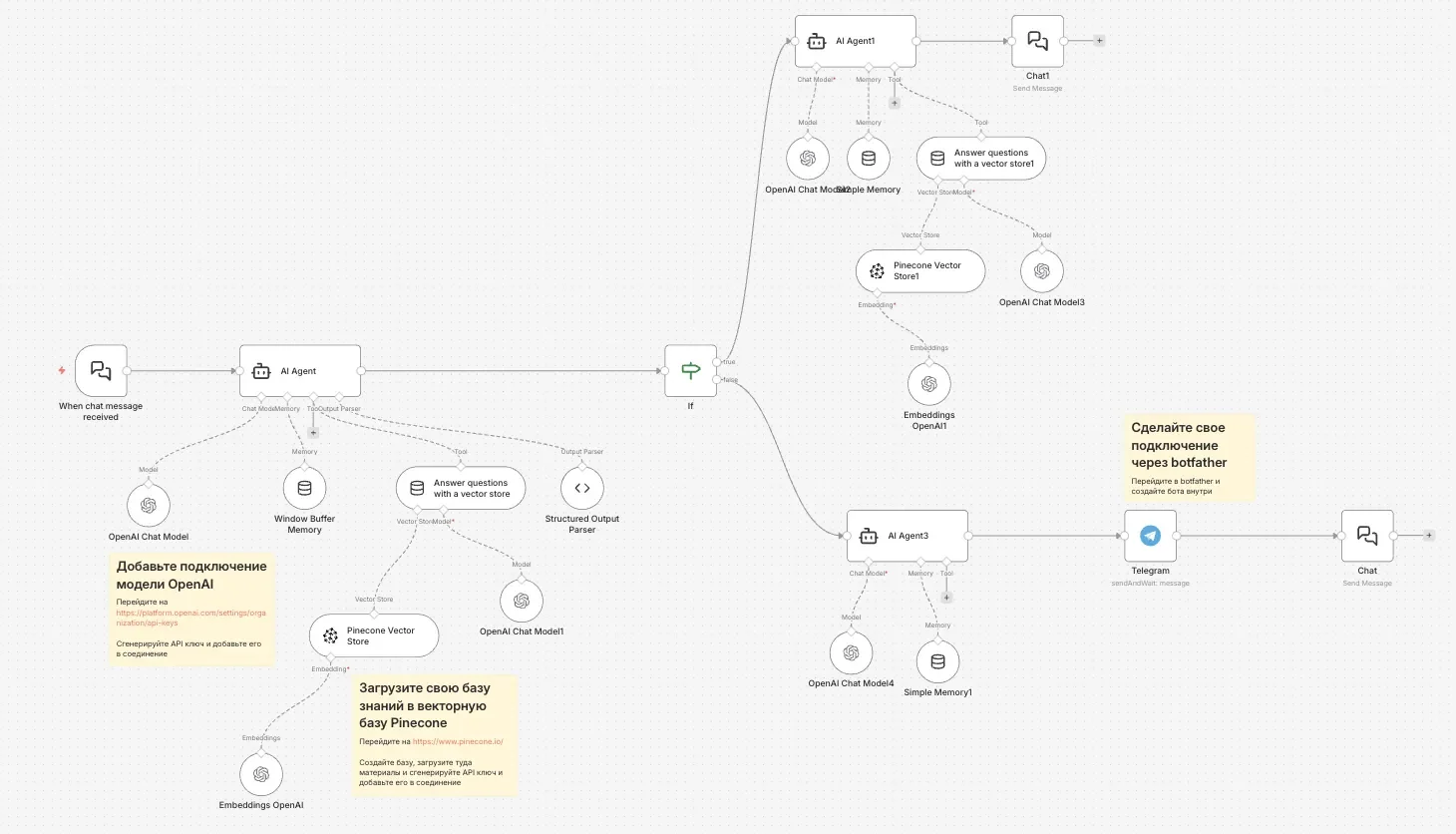
How the process works: A new employee receives access to the bot → whenever a question arises, the bot searches the company’s
knowledge base through RAG, using a vector database and documents such as policies, FAQs, and the organizational structure → if it finds
an answer, it returns it with its source → otherwise, it automatically escalates the question to the HR manager
with context.
Core components: Telegram Bot → AI Agent + RAG (Pinecone/Supabase + documents) → Telegram
(HR escalation) → Schedule (onboarding plan tasks)
💡 No structured knowledge base? That is not a problem.
Contact us by email and we will help you assemble and launch the assistant in stages.
CASE 3.3 Automating HR document workflows
The challenge: HR spends a significant amount of time creating repetitive documents: orders,
employment contracts, addenda, and certificates. With 50 or more employees, this takes several hours a day.
The AI solution: An AI system automatically generates HR documents using data from
the records system: it fills templates, validates the data, and sends documents for approval and
electronic signature. Integration with 1C or an electronic HR document management system completes the entire cycle without manual
entry.
Expected result: Time spent on document workflows falls by 70–80%. Document errors,
such as incorrect dates, details, or wording, are minimized. HR focuses on
people instead of paperwork.
Implementation complexity: ⭐⭐⭐ Medium
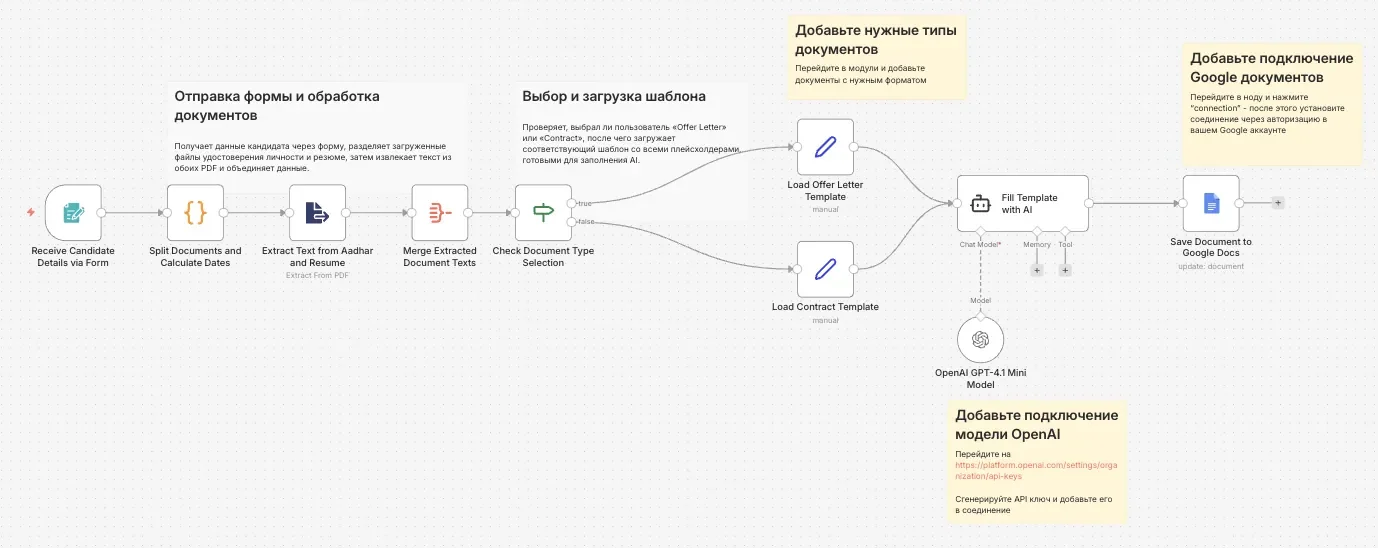
How the process works: HR initiates document creation through a form or bot command, providing the document type and employee data → AI fills a template for an order, contract, or addendum, checks the accuracy
of details and dates, and creates a Google document.
Core components: Form/Bot Trigger → Document retrieval (employee data) → AI Agent
(template completion + validation) → Google Docs
Download the ready-made workflow
💡 Working with 1C or another records system? Contact us by email and we will explain how to set up the integration.
Additional AI use cases in HR processes
The following use cases are not provided as ready-made blueprints. Each is implemented in fundamentally different ways depending on the technology stack, data, internal processes, and company maturity. If you would like to implement one, contact us by email and we will explore it for your situation.
Writing job postings and adapting them to platforms
AI generates a job posting from a hiring manager’s brief, adapts it for different platforms such as hh.ru, LinkedIn, Telegram, and Avito, selects keywords for their algorithms, and publishes the vacancies. Preparation time drops from 2 hours to 15 minutes.
Automating communication with candidates
An AI agent automatically sends the right message at the right funnel stage: acknowledgment when a resume arrives, an invitation after screening, a reminder 24 hours before the interview, a status update afterward, and a personalized rejection with feedback. All communications follow the company’s tone of voice.
HR analytics and employee turnover forecasting
The model analyzes available employee data: tenure, performance score trends, frequency of HR inquiries, promotion history, workload, and activity in internal systems. It produces a ranked list of employees at risk of leaving, with the key risk factors for each. HR and managers can then act proactively.
360-degree feedback and assessment
AI automatically collects structured responses from colleagues, managers, and direct reports on defined competencies. It aggregates results, removes extreme outlier scores, and identifies patterns and differences between self-assessments and external assessments. It creates a personalized report with specific growth areas and recommendations.
Your order
You can pay for the guide in rubles or with a foreign-issued card