
SkaiLab
Content generation, distribution, and analytics with AI
Marketing is the first area where teams begin using AI, but this is often limited to writing posts. Real efficiency comes from a systematic approach in which artificial intelligence becomes a fully fledged factory for producing and distributing messages.
This section explores how AI can multiply a brand’s media presence without expanding the marketing team.
The technology can automate the entire cycle, from collecting industry news and generating SEO articles to creating hundreds of advertising variations and personalized email sequences.
This approach turns marketing into a precise system in which every message is tailored to a specific audience segment and communication channel.
AI does not replace creators, but lets them scale one strong idea into dozens of formats in minutes, significantly reducing the cost of reaching a potential customer.
Marketing is the first area where most teams begin using AI. But this usually comes down to ‘write a post in ChatGPT.’ Systematic AI use in marketing means established content production and distribution processes, automatic personalization, and continuous performance analysis.
Key areas for automation in sales
- Generating and adapting content for different formats and channels
- SEO optimization and articles targeting search queries
- Automated campaigns and email marketing
- Analyzing and monitoring brand mentions
- A/B testing headlines and advertising copy
- Transcribing and creating content from videos and podcasts
- Personalizing landing pages and advertising messages
- Analyzing competitors’ content and finding topics
CASE 2.1 Content automation: one piece, multiple formats
The challenge: A marketer writes an article or blog post. But a full presence also requires
LinkedIn, Telegram, and Twitter posts, a short video, an email newsletter, and Instagram cards.
Repurposing takes an entire day.
The AI solution: An AI agent receives the source material—an article, interview, or webinar recording—and
automatically creates a LinkedIn post in a professional tone, a conversational Telegram post, a series
of tweets, key points for an email newsletter, headlines for an A/B test, and 5 caption options for a card. Every
format is ready in 5–10 minutes.
Expected result: Content output increases 5–8 times without expanding the team. All channels
are updated regularly. Reach grows, and the cost per contact falls.
Implementation complexity: ⭐⭐ Low (1–2 days of setup)
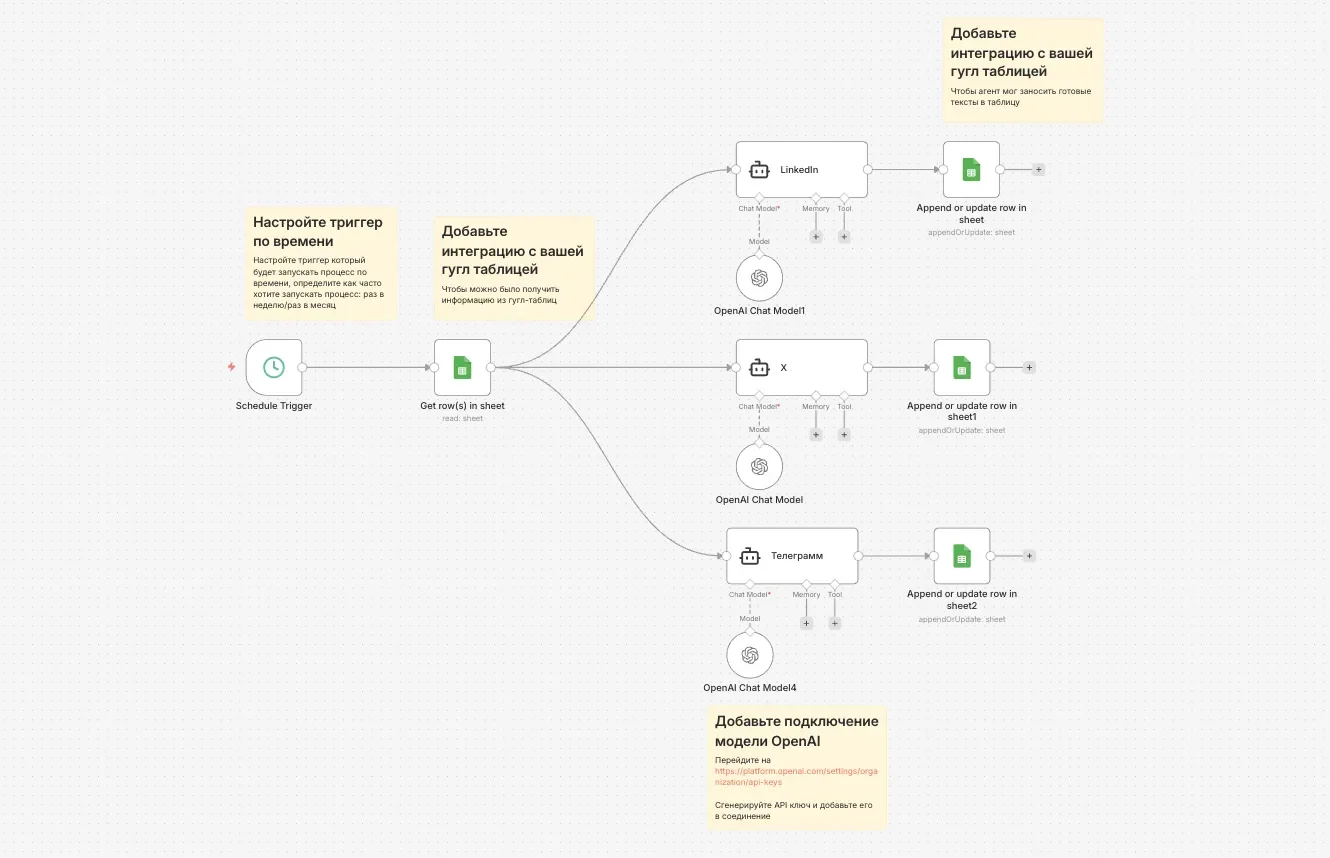
How the process works: Source material—an article, webinar transcript, or notes—is uploaded to a Google Sheet → the AI agent analyzes its structure and key points → generates adapted versions: a professional LinkedIn post, a conversational Telegram post, and a series of tweets → all formats are stored in Google Sheets for review and publication planning.
Core components: Schedule Trigger → AI Agent (analysis + generation in multiple formats) → Google Sheets
Download the ready-made workflow
💡 Want to adapt it to your channels and tone of voice?
Contact us by email and we will help tailor content generation to your brand.
CASE 2.2 SEO generation: automatic articles targeting search queries
The challenge: SEO content requires substantial resources: keyword research, article writing,
and meta tag optimization. Small teams cannot produce the volume they need.
The AI solution: An AI system analyzes the keyword set daily, selects queries with
potential—low competition and high volume—generates an article outline, writes a complete
text with headings, a meta description, and internal links, and publishes it in the CMS. A person only
reviews the final version.
Expected result: Output increases from 4–8 articles per month to 30–50. Organic
traffic starts growing after 3–4 months. The cost of an SEO article drops from RUB 5,000–15,000
to RUB 500–1,000.
Implementation complexity: ⭐⭐⭐⭐ High (requires SEO tool and CMS configuration)
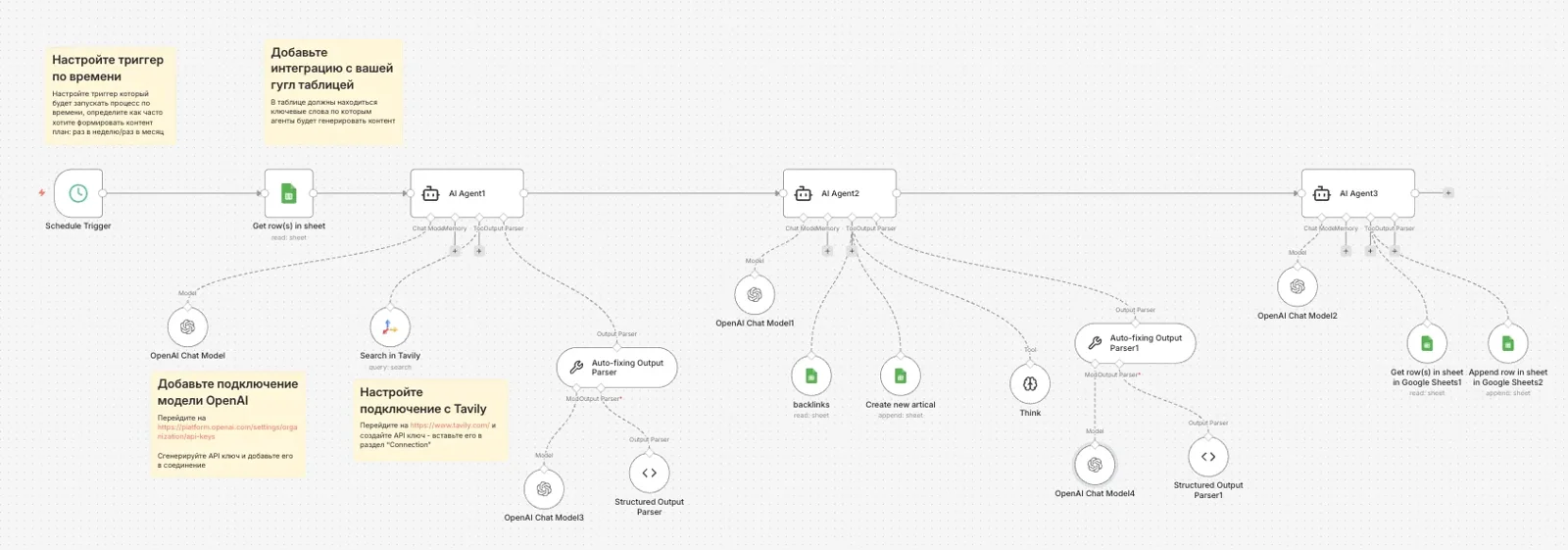
How the process works: The agent receives a list of search keywords from an SEO tool or spreadsheet → uses Tavily/SerpAPI to analyze current search results and competitors for each query → the AI agent creates an article outline with H1–H3 headings, a meta description, and internal links → generates the full text and stores it in Google Sheets for later publication.
Core components: Schedule/Manual Trigger → SEO API / Google Sheets → Tavily/SerpAPI (search result analysis) → AI Agent (outline + text) → Google Sheets
Download the ready-made workflow
💡 Need help connecting your CMS or SEO tools? Contact us by email and we will configure the workflow for your stack.
CASE 2.3 Personalized email sequences for different segments
The challenge: Everyone receives the same emails. Personalization extends only to the name in
the greeting. Open rates fall, and unsubscribes increase.
The AI solution: Based on segmentation by industry, size, website behavior, and funnel
stage, AI generates unique emails for each segment. Tone, examples, and the call to
action are all adapted. The system also tests subject lines and optimizes send times.
Expected result: Email open rates increase by 30–50%. CTR grows 2–3 times.
Unsubscribes fall. Email revenue grows while the contact database stays the same size.
Implementation complexity: ⭐⭐⭐ Medium (requires a segmented contact database)
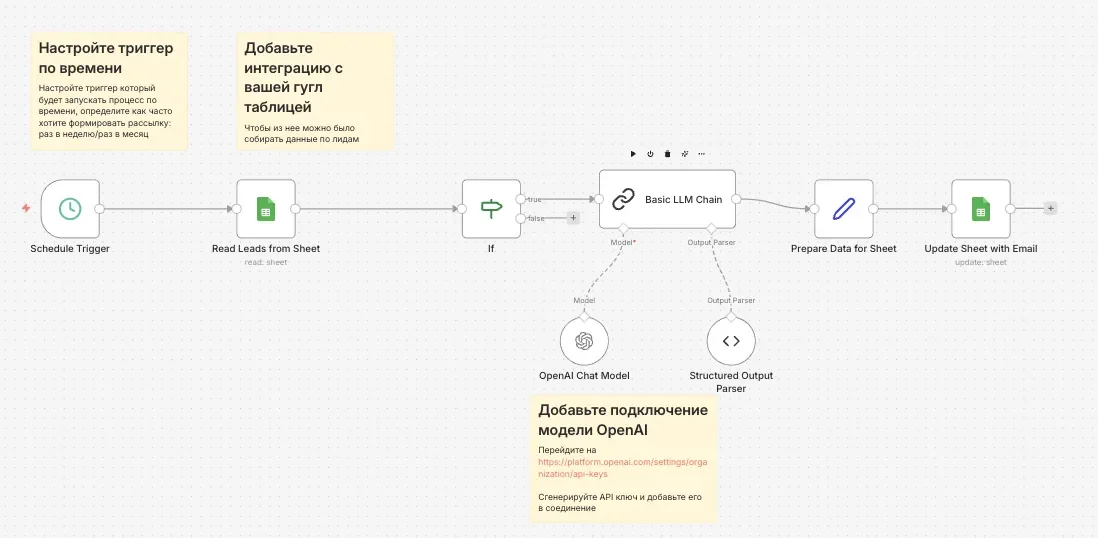
How the process works: Contacts and attributes—industry, size, funnel stage, and website behavior—are exported from the CRM or subscriber database → the AI agent segments the database and generates unique emails for each segment: subject, body, CTA, and send time → emails are uploaded to Google Sheets for later publication.
Core components: CRM API / Google Sheets → AI Agent (segmentation + generation) → Google Sheets
Download the ready-made workflow
💡 Want a digest like this for your industry?
Contact us by email and we will help structure the emails around your funnel.
CASE 2.4 Automatic industry digest for content marketing
The challenge: Creating expert content requires continuously tracking industry trends, reading
research, and analyzing competitors. This takes several hours each week.
The AI solution: Every morning, an AI agent collects news from 30–50 sources, including industry
media, LinkedIn, Telegram channels, and academic publications, filters it for relevance, prepares
a short digest, and proposes 5–10 content topics with suggested angles. The marketer chooses,
and the agent writes a draft.
Expected result: The marketer spends 10 minutes choosing topics instead of 2 hours. Content becomes
more timely and expert. Audience engagement increases.
Implementation complexity: ⭐⭐ Low
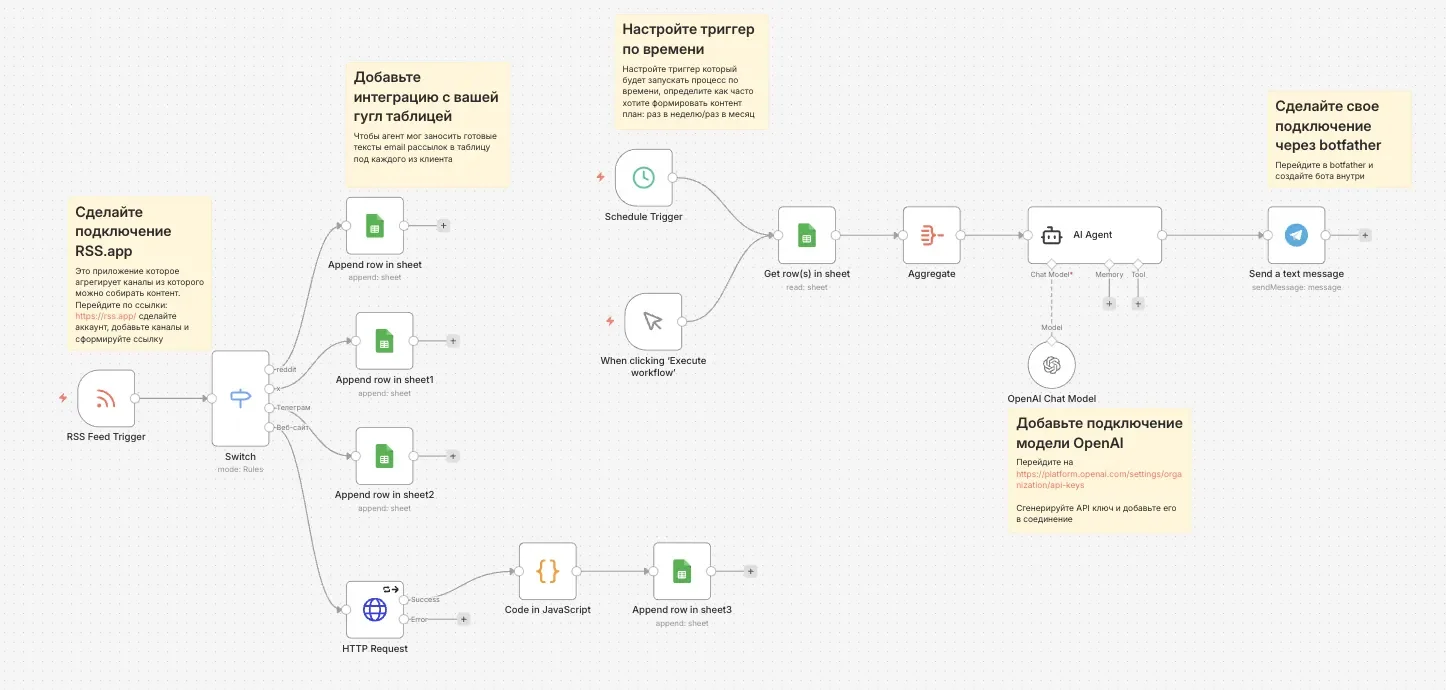
How the process works: Each morning on a schedule, the agent visits 30–50 sources: industry media RSS feeds, Telegram channels via the TG API, LinkedIn, and research aggregators → the AI agent filters for relevance and ranks by significance → creates a short digest with the top 10 stories and proposes 5–10 content topics with recommended angles → delivers it to the marketer through Telegram or email.
Core components: Schedule Trigger → RSS / HTTP Request / Telegram API → AI Agent (filtering +
ranking + topic generation) → Telegram/Email
Download the ready-made workflow
💡 Want to try it on your own vacancies? Contact us by email and we will select sources and configure the format.
Additional AI use cases in marketing processes
The following use cases are not provided as ready-made blueprints. Each is implemented in fundamentally different ways depending on the technology stack, data, internal processes, and company maturity. If you would like to implement one, contact us by email and we will explore it for your situation.
Monitoring brand and competitor mentions
An AI agent scans social networks, Telegram channels, review sites, forums, and media daily. It classifies mentions by sentiment and topic, escalates critical ones, and prepares a weekly digest. Reputation risks are addressed within hours, rather than a week later.
AI advertising campaign analyst
The agent retrieves data from advertising accounts such as VK Ads, Yandex Direct, Meta, and Google every day, compares results across audiences, placements, and creatives, and identifies what wastes budget and what should scale. It prepares a morning report with specific recommendations: ‘pause,’ ‘increase the bid,’ or ‘test a variation.’ The marketer makes decisions based on data rather than intuition, without manually combining spreadsheets.
Automatic advertising creative generation
Based on the offer, target audience, and analysis of the best historical creatives, AI generates a complete testing package: 10–20 copy variations with different angles—pain points, benefits, social proof, and urgency—adapted to each placement. At the same time, a Krea.ai integration generates visuals for each format: banners, stories, and squares. Everything is labeled by hypothesis: which angle is being tested, for which audience, and against which KPI. The marketer receives a complete, structured package ready to upload to the advertising account.
Your order
You can pay for the guide in rubles or with a foreign-issued card