SkaiLab
Funnel automation, database management, and lead qualification
In modern business, sales has long since become more than the art of communication: it is now about data and response speed. Introducing artificial intelligence into this department can transform the sales funnel from a chaotic flow into a predictable mechanism.
AI’s main value here is freeing the company’s most expensive resource: the time of a qualified sales representative.
Instead of manually sifting through incoming inquiries, studying dozens of websites before a call, or spending hours completing reports after each meeting, employees can focus on closing deals and building relationships with key customers.
Automation reduces time spent on routine operations and significantly improves the quality of every interaction through deep personalization and tools that intelligently enrich customer information from public sources.
The result is higher conversion and a shorter sales cycle.
Sales is one of the most mature areas for AI adoption. Every hour of a representative’s time has measurable value, the volume of routine work is enormous, and data is generally already structured in a CRM. AI addresses three main sales challenges: reducing routine work, improving customer interactions, and making results more predictable.
Key areas for automation in sales
- Qualifying and prioritizing incoming leads
- Preparing for calls and meetings by gathering customer context
- Automatically transcribing and analyzing calls
- Personalized follow-up emails after meetings
- Preparing sales proposals and presentations
- Forecasting deals and their likelihood of closing
- Enriching customer records from public sources
- Analyzing competitors when preparing a tender response
CASE 1.1 Automatic qualification of incoming leads
The challenge: Sales representatives spend up to 40% of their time on initial inquiry processing: reading emails, making calls
to clarify needs, and manually entering CRM data. A significant proportion of leads
turn out to be a poor fit.
The AI solution: An AI agent receives an incoming inquiry from a website form, email, or chat,
analyzes it, automatically asks clarifying questions through a messaging app or email,
assigns a lead score against defined criteria such as budget, timing, job role, and industry, and
passes qualified leads to the appropriate representative with an already completed CRM record.
Expected result: Qualification time falls by 60–70%. Sales representatives work
only with hot leads. Lead-to-meeting conversion increases by 20–35%.
Implementation complexity: ⭐⭐⭐ Medium (requires CRM and messaging integrations)
The implementation is shown as an AmoCRM integration; you can replace it with your own CRM.
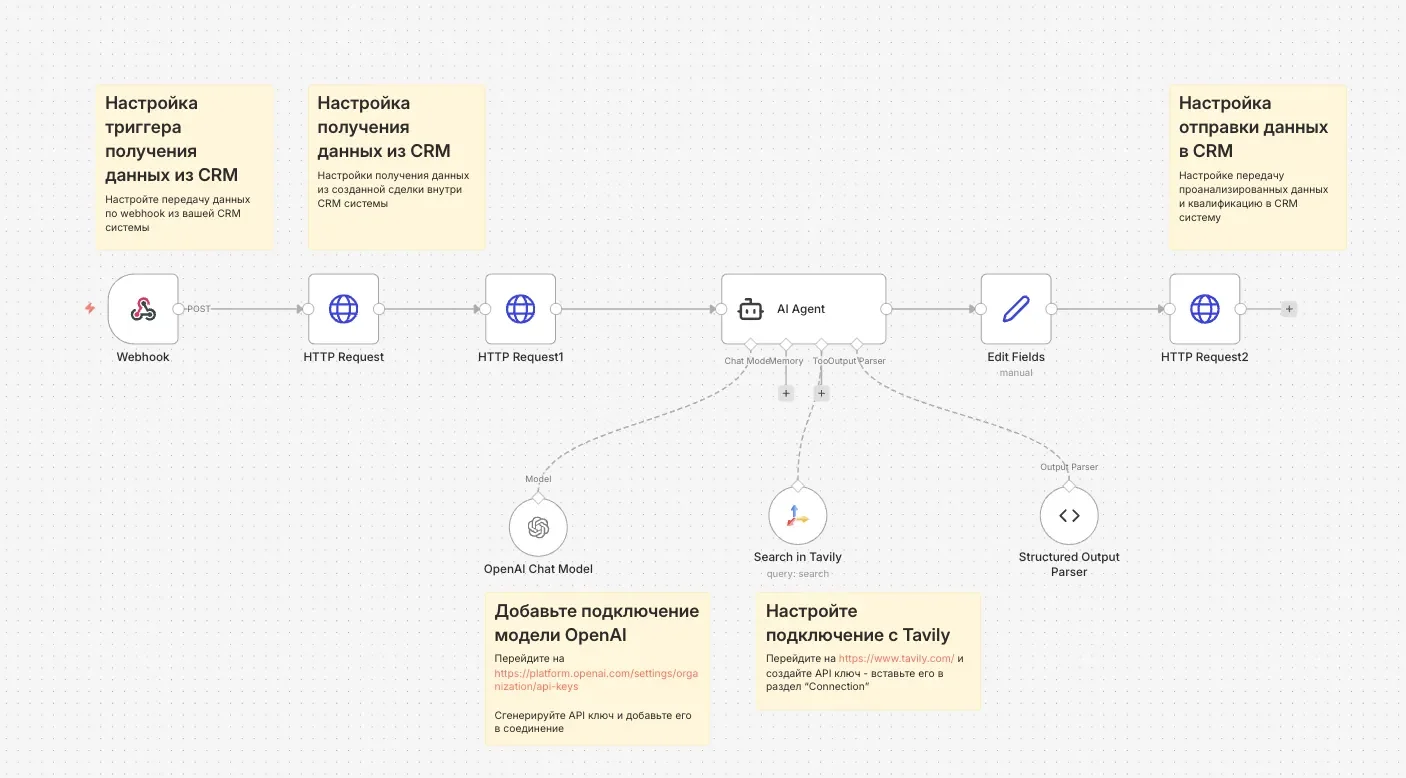
How the process works: An inquiry arrives through a webhook from a website form or messaging app → data reaches a processing node, where a Claude/GPT-powered AI agent researches the lead and assigns a lead score against defined criteria such as budget, industry, and urgency → a qualified lead with a completed record is automatically created in AmoCRM and assigned to the appropriate representative.
Core components: Webhook → AI Agent (Claude/GPT) → AmoCRM API
Download the ready-made workflow
💡 Something not working, or need setup help?
Contact us by email and we will work through it together and adapt it to your CRM.
CASE 1.2 Preparing a sales representative for a call in 2 minutes
The challenge: Before every call, a representative spends 15–30 minutes researching the customer’s website, correspondence
history, company news, and previous interactions. With many meetings, this is unrealistic.
The AI solution: Two minutes before the call, an AI agent gathers a brief description of the company and its
business, recent news such as financial results, deals, and changes, interaction history from the
CRM, and previous decisions and objections. Everything is compiled into a short brief and sent
to the representative through Telegram or Slack.
Expected result: The representative joins the call prepared. The customer feels
understood. Personalization increases deal conversion by 15–25%.
Implementation complexity: ⭐ Low (1 day of setup with existing integrations)
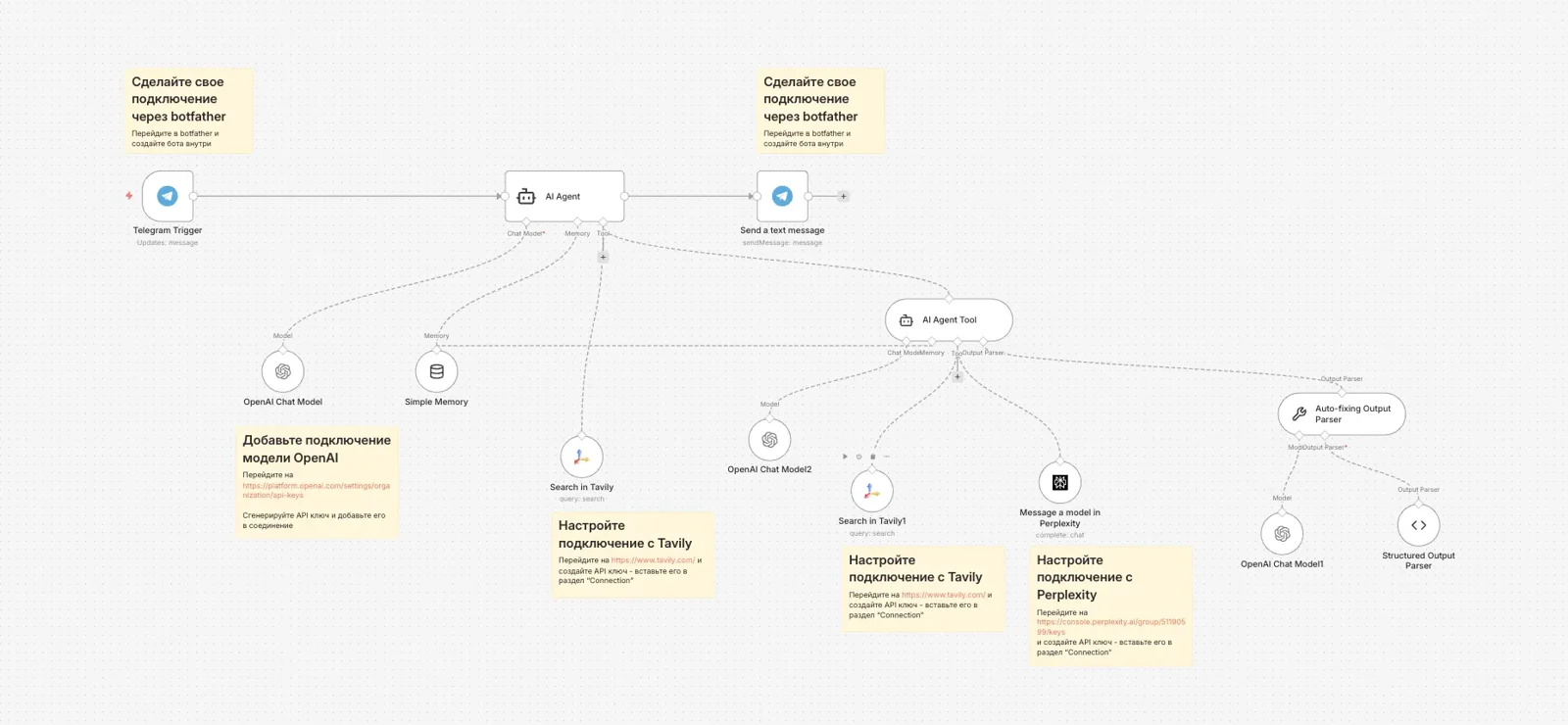
How the process works: The representative sends the customer’s website as the trigger → the agent retrieves customer information → parses the customer’s website through Tavily → retrieves recent news through Tavily → the AI agent compiles a short brief of 5–7 points → sends it to the representative through Telegram.
Core components: Telegram Bot → Tavily (web search) → AI Agent (summarization) → Telegram Bot
Download the ready-made workflow
💡 Need help configuring integrations? Contact us by email and we will explain how to connect your CRM and messaging apps.
CASE 1.3 Call analysis and automatic follow-ups
The challenge: After every call, the representative should record the results in the CRM, write a customer follow-up,
and create tasks for the next step. In practice, this rarely happens, and details are lost.
The AI solution: The call recording is automatically transcribed using Whisper or Deepgram. Claude
analyzes the text and extracts key agreements, customer objections, next steps,
and the conversation’s tone. The analysis automatically creates a CRM task, drafts
a follow-up email for the representative’s approval, and updates the customer record.
Expected result: 100% of call outcomes are recorded. Time spent on post-call work
drops from 20 to 3 minutes. The manager receives analytics on all negotiations in real
time.
Implementation complexity: ⭐⭐⭐ Medium (requires access to call recordings)
How the process works: A call recording arrives from the telephony system as a file or link → it is transcribed through Deepgram → the text is passed to an AI agent, which extracts agreements, objections, next steps, and sentiment → the analysis produces a draft follow-up email and CRM task → the representative receives a Telegram notification with a summary and task link for approval.
Core components: Webhook (telephony) → Whisper/Deepgram (transcription) → AI Agent (analysis) →
AmoCRM API (task + record update) → Email/Telegram (follow-up)
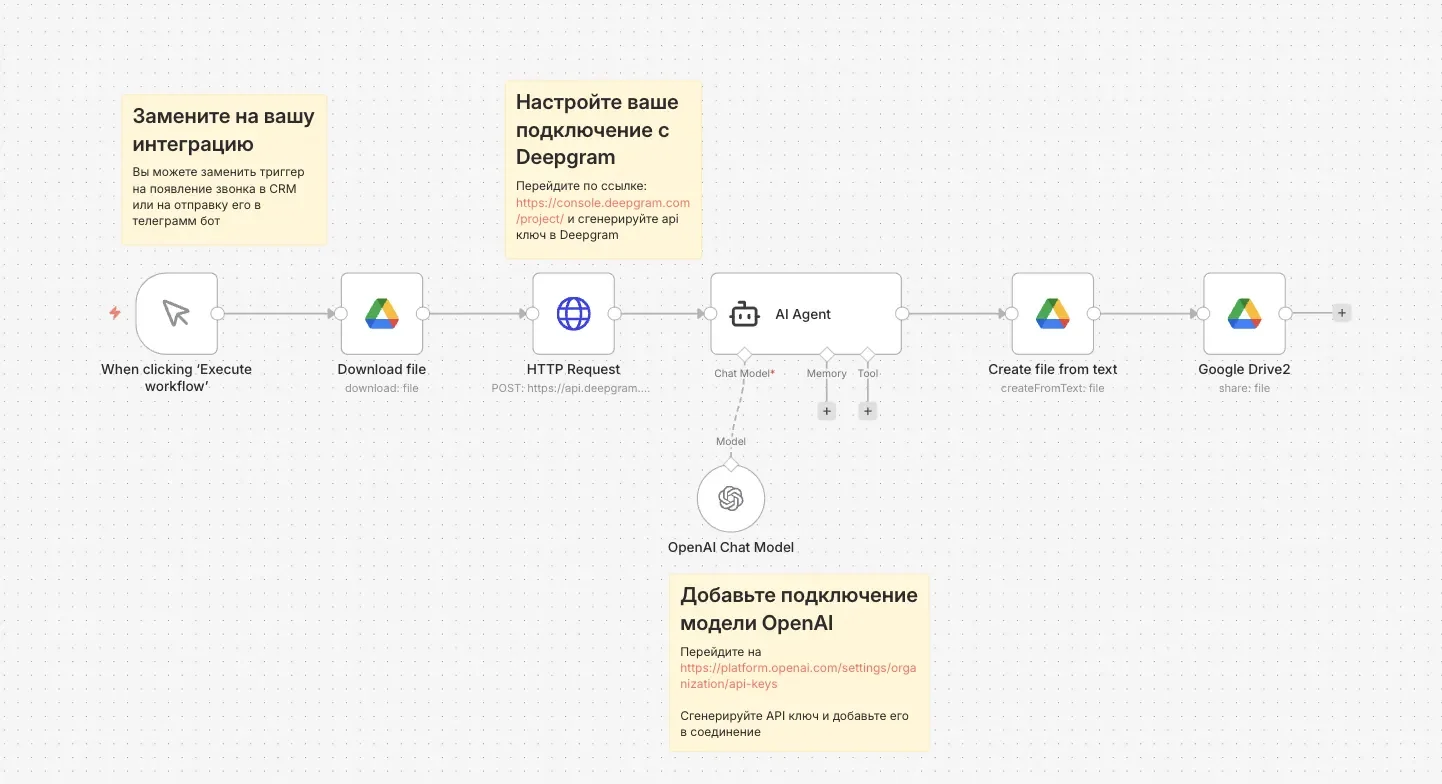
Download the ready-made workflow
💡 Want to launch this process in your company? Contact us by email and we will help configure it for your stack and call format.
CASE 1.4 Reactivating dormant customers
The challenge: Every CRM accumulates hundreds of leads who once expressed interest but did not
convert. Managers know the database holds revenue opportunities, but lack the resources for manual
reactivation.
The AI solution: An AI agent analyzes the customer database, segments it by time since last contact,
industry, and source, generates personalized emails or messages for each segment,
sends them on a schedule, records responses, and passes warm contacts to sales representatives.
Expected result: A dormant database of 500 contacts can typically reactivate 5–15%, with
conversion into deals. With an average deal value starting at 100K, the automation pays for itself in the first
reactivation campaign.
Implementation complexity: ⭐⭐ Low (1–2 days with an existing CRM database)
The implementation is shown as an AmoCRM integration; you can replace it with your own CRM.
How the process works: On a schedule, the agent exports CRM contacts with no activity for N days →
segments them by recency, industry, and source → AI generates a personalized message for each segment based on interaction history → messages are stored by customer in a Google Sheet for later sending, which can also be automated.
Core components: Schedule Trigger → AmoCRM API (export + filtering) → AI Agent (segmentation + text generation) → Google Sheets (recording information)
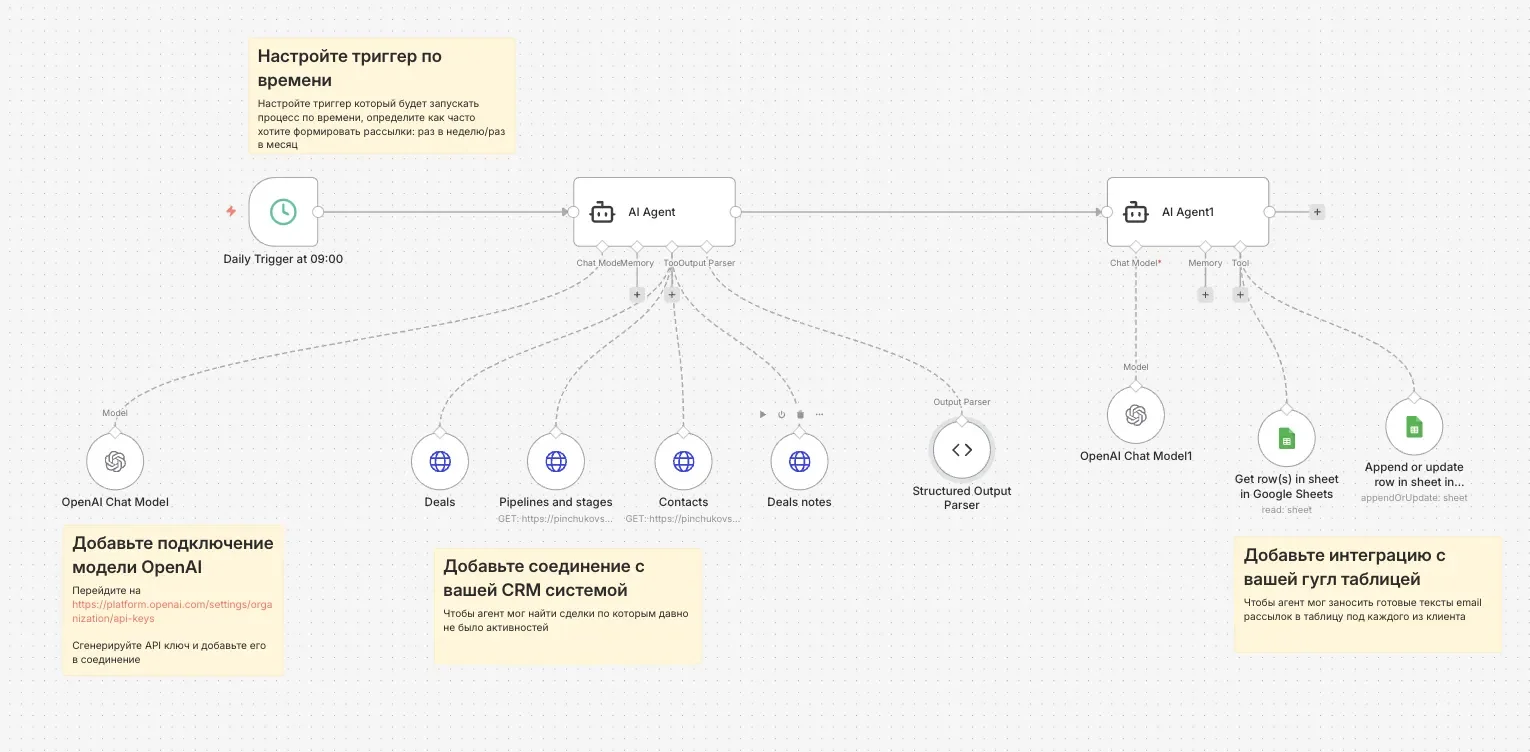
Download the ready-made workflow
💡 Have a database but unsure how to start reactivating it?
Contact us by email and we will show you how to adapt the scenario to your segments.
CASE 1.5 Competitor monitoring and sales triggers
The challenge: Sales representatives rarely know what is happening at a customer’s competitors: new products, changes
of suppliers, and job openings are all sales triggers. Monitoring them manually is impossible.
The AI solution: Every day, an AI agent scans customers’ competitors’ websites, LinkedIn,
Telegram channels, and news aggregators. When it finds a trigger event, such as a new CEO, a CTO
vacancy, or a published tender, the company receives a notification with
the update.
Expected result: Representatives receive 3–5 strong reasons to call each week instead of none.
Deal conversion from trigger-based interactions is 2–3 times higher than from cold outreach.
Implementation complexity: ⭐⭐⭐ Medium (requires monitoring source configuration)
How the process works: Each day on a schedule, the agent reads a predefined source list from a spreadsheet: competitor websites, LinkedIn, and Telegram channels → an AI agent uses FireCrawl to collect website information → another AI agent compares website changes and identifies trigger events such as leadership changes, vacancies, tenders, new products, and price changes →
a digest of specific changes is created → delivered to representatives through Telegram.
Core components: Schedule Trigger → FireCrawl → AI Agent (trigger filtering + classification) → Telegram
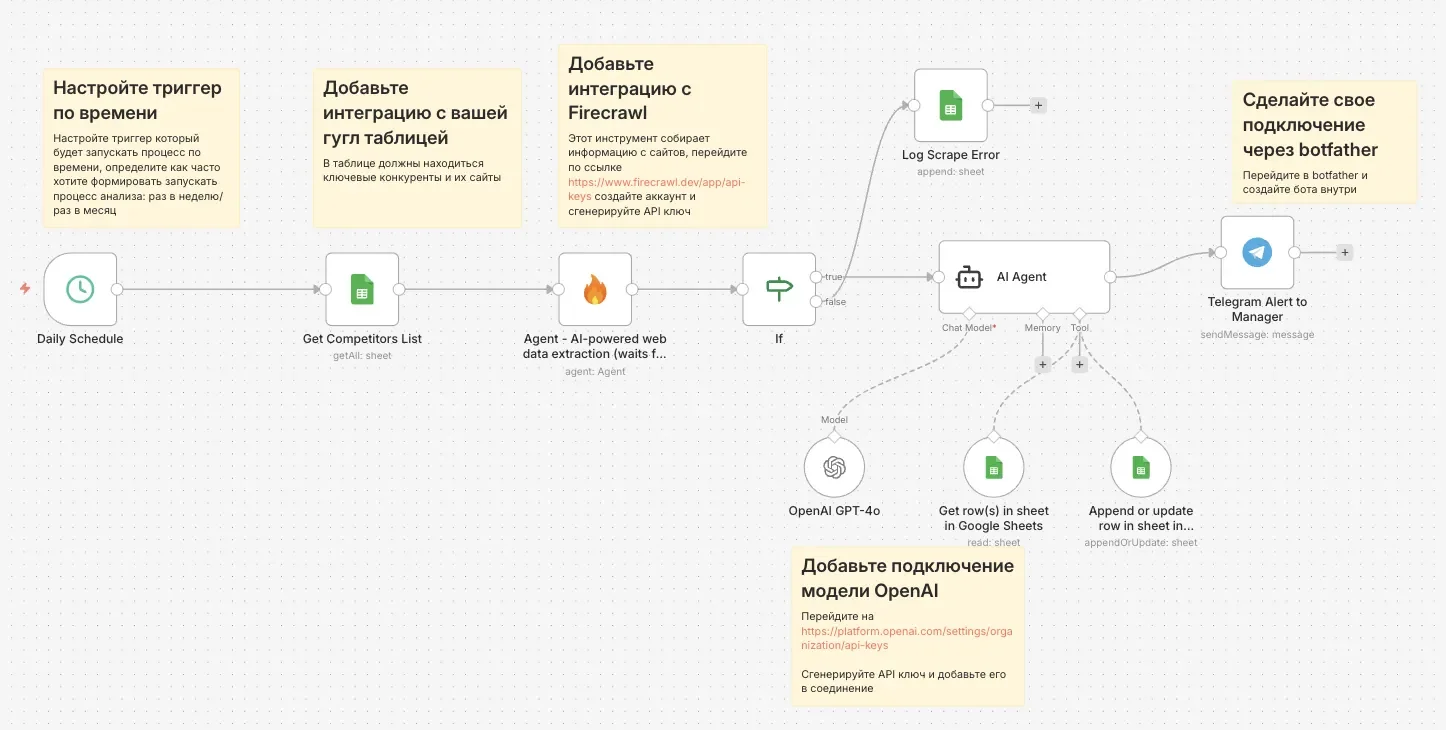
Download the ready-made workflow
💡 Want monitoring tailored to your niche? Contact us by email and we will select sources and configure triggers.
Additional AI use cases in sales processes
The following use cases are not provided as ready-made blueprints. Each is implemented in fundamentally different ways depending on the technology stack, data, internal processes, and company maturity. If you would like to implement one, contact us by email and we will explore it for your situation.
Preparing sales proposals and presentations
An AI agent automatically creates a personalized sales proposal from CRM customer data, negotiation history, and company templates. The representative receives a complete draft with the right figures, case studies, and wording, then spends 10 minutes finalizing it instead of 2 hours.
Forecasting the likelihood of closing a deal
The model analyzes patterns in historical deals, including cycle length, number of interactions, customer type, and activity, and assigns each open deal a closing probability in real time. The manager sees the pipeline through data rather than representatives’ perceptions.
Voice AI agent for initial lead qualification
An incoming call or website inquiry is handled by a voice agent: it asks qualification questions, recognizes intent, identifies budget and timing, completes the CRM record, and either schedules a meeting with a representative or transfers the call live. It works 24/7, with no missed
inquiries or lost leads outside business hours. Instant responses increase conversion from incoming inquiries to qualified leads by 30–40%.
AI quality control for sales representatives
The system automatically analyzes all call recordings against defined criteria: script compliance, quality of needs discovery, objection handling, representative-to-customer talk ratio, and use of prohibited words. Each representative receives a personal profile of strengths and weaknesses with specific recommendations. The manager sees aggregate team analytics without manually listening to calls. Conversion increases by 15–25% through systematic coaching rather than isolated interventions.
Your order
You can pay for the guide in rubles or with a foreign-issued card