
SkaiLab
Routine automation, analytics, and control in finance
A company’s finance function is ideally suited to automation because it works with structured data and repetitive operations.
Introducing AI here helps address two main goals: dramatically speeding up accounting and minimizing human error.
Artificial intelligence can instantly extract data from scanned invoices and acceptance certificates, automatically assign it to expense categories, and reconcile records across systems.
This transforms accounting from a department constantly catching up with reality into a source of timely data for managing the business.
Moreover, AI becomes an indispensable control tool, identifying anomalies and suspicious payments before money leaves the company’s accounts.
The finance department thus moves from simply recording the past to forecasting future scenarios, helping management make informed decisions based on current figures rather than intuition.
The finance function traditionally works with large volumes of structured data and repetitive operations. This makes it ideal for automation. AI accelerates processes while also identifying anomalies, reducing error risks, and freeing analysts for strategic work.
Key areas for automation in sales
- Automatic processing of source documents: invoices, acceptance certificates, and delivery notes
- Data reconciliation across multiple systems
- Financial forecasting and budgeting
- Anomaly detection and fraud monitoring
- Automatic preparation of management reports
- Accounts receivable analysis and automatic reminders
- Data preparation for tax reporting
- Monitoring expenses against the budget
CASE 4.1 Automatic processing of incoming invoices and acceptance certificates
The challenge: Accountants manually enter data from invoices and acceptance certificates into the accounting system: supplier,
amount, date, number, and expense category. With 100+ documents per month, this means several days of routine
work with a high risk of errors.
The AI solution: An AI agent receives a document, whether a PDF, scan, or photo, and an LLM extracts the key
data, classifies it by expense category based on context, creates an accounting entry,
and sends it to the responsible person for approval. The person only needs to confirm it.
Expected result: Processing time per document drops from 5–10 minutes to 30–60
seconds. Data entry accuracy is 99%+. An accountant processes 5–8 times more documents in
the same amount of time.
Implementation complexity: ⭐⭐ Low (1–2 days of setup)
How the process works: A document, whether a PDF, scan, or photo, is uploaded to Google Drive → text is extracted
from the document → the AI agent recognizes and extracts key fields: supplier, amount, date, number, and VAT
→ classifies it by expense category based on context and history → creates an accounting entry → sends it to the responsible person for approval with a data preview.
Core components: Email Trigger / Webhook → OCR (if needed) → AI Agent (field extraction + classification) → accounting system → Telegram/Email (approval)
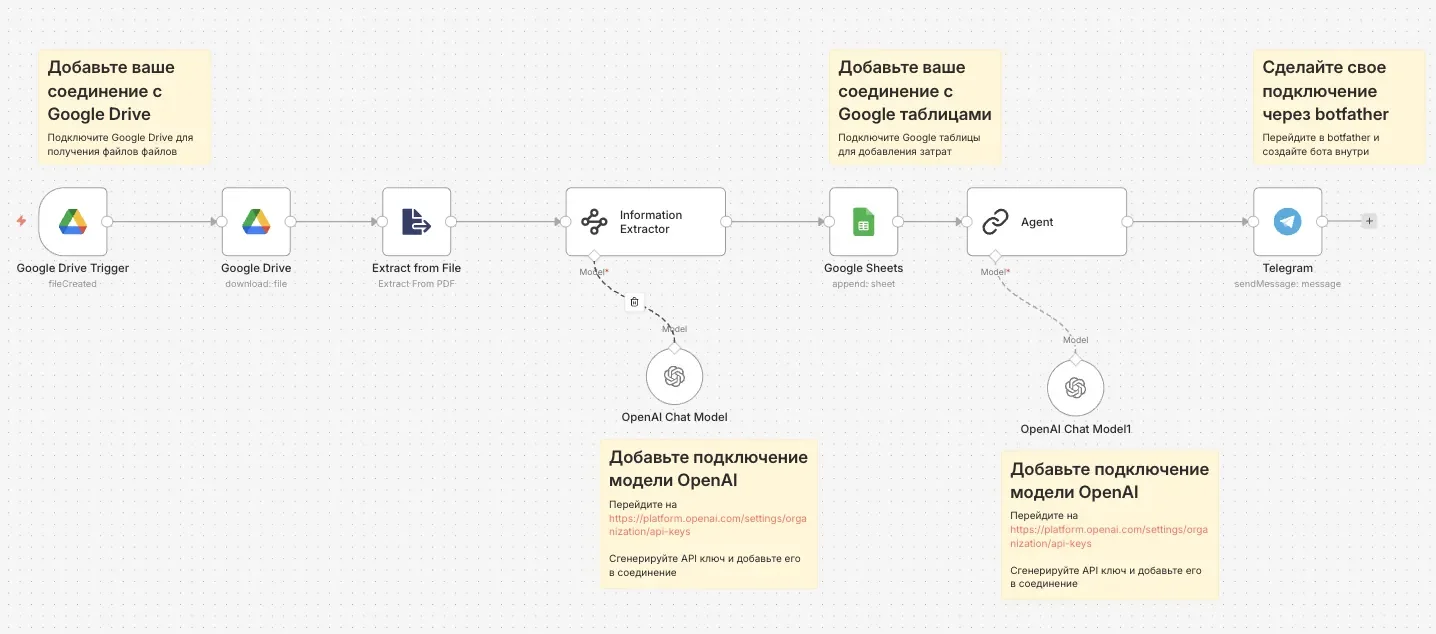
Download the ready-made workflow
💡 Want to test it on your own documents?
Contact us by email and we will show you how to get it running with real invoices in a couple of days.
CASE 4.2 Automatic accounts receivable reminders
The challenge: Monitoring receivables is a daily task for the finance department. Calling each debtor
manually and sending emails is labor-intensive. Many companies miss out on money simply because they cannot
send reminders in time.
The AI solution: An AI system scans the accounts receivable register daily. When
payment falls due, it automatically sends a polite reminder. After 3
days overdue, it sends another reminder with the amount. After 7 days, it escalates to a manager. Tone and wording
are customized for each customer segment.
Expected result: The average collection period falls by 20–35%. The finance
department spends no time on routine calls. Cash flow improves.
Implementation complexity: ⭐⭐ Low (1–2 days with an existing accounting system integration)
How the process works: On a daily schedule, the agent exports the accounts receivable register from the
accounting system → filters by due dates: upcoming, 3 days overdue, and 7+ days overdue → AI
generates reminder text tailored to the customer segment and amount → sends it via email/Telegram.
Core components: Schedule Trigger → 1C / accounting system → AI Agent (segment-specific text generation) → Email/Telegram
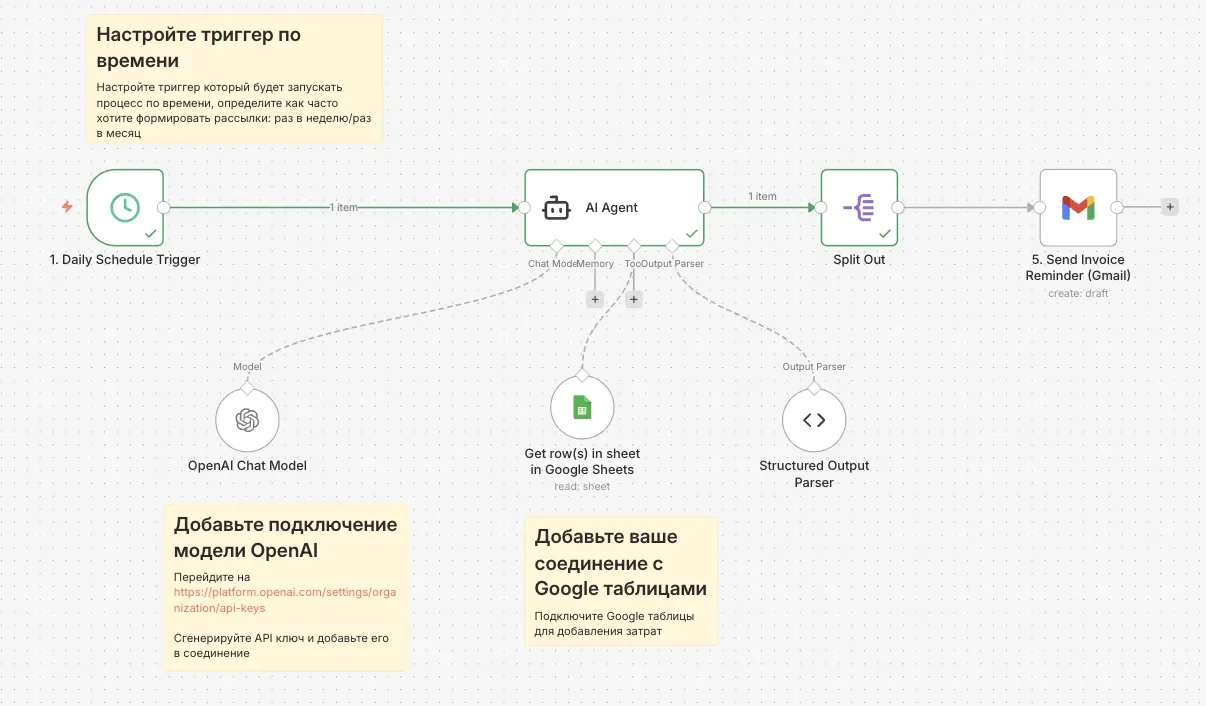
Download the ready-made workflow
💡 Need to connect it to your accounting system? Contact us by email and we will tailor it to your debt collection process.
CASE 4.3 Detecting expense anomalies
The challenge: Fraudulent transactions, duplicate payments, and unusual expenses are difficult
to spot manually among hundreds of monthly transactions. Checking after the fact often means the money has already
been lost.
The AI solution: An AI model is trained on the company’s historical transaction data and
detects deviations: unusually large amounts, unfamiliar recipients, suspicious patterns,
and duplicates. When an anomaly is detected, the financial controller receives an immediate notification
explaining why it was flagged.
Expected result: The company identifies potentially fraudulent or erroneous transactions
at an early stage. Anomaly detection accuracy is 85–95% with proper configuration. Savings
exceed the implementation cost within the first quarter.
Implementation complexity: ⭐⭐⭐ Medium
How the process works: The agent regularly exports transactions from the accounting system → the AI model compares
each transaction with historical patterns: typical amounts per counterparty, payment frequency, and expense
categories → when it detects a deviation, such as an unusual amount, new recipient, or duplicate, it creates an alert explaining
the trigger → the financial controller receives a notification for review.
Core components: Schedule Trigger → 1C / bank API (transaction export) → AI Agent (pattern analysis + anomaly detection) → Telegram/Email (alert with explanation)
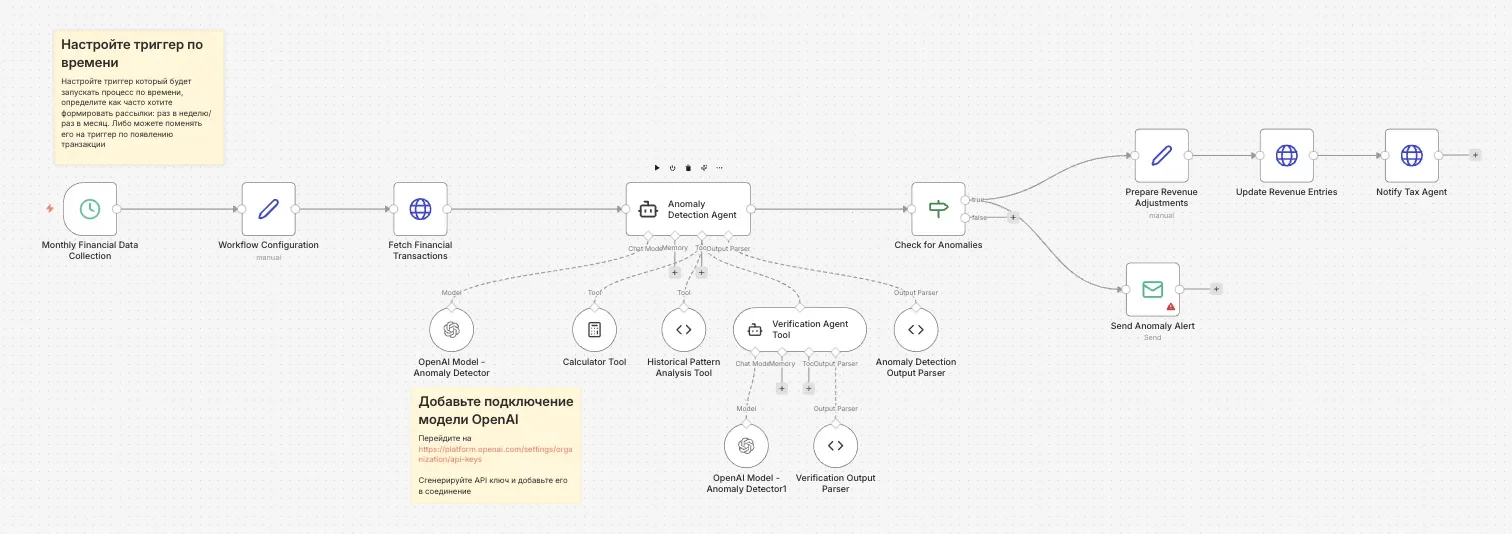
Download the ready-made workflow
💡 Want to check your data for anomalies?
Contact us by email and we will carry out an initial analysis and show you what can be automated.
Additional AI use cases in finance and accounting
The following use cases are not provided as ready-made blueprints. Each is implemented in fundamentally different ways depending on the technology stack, data, internal processes, and company maturity. If you would like to implement one, contact us by email and we will explore it for your situation.
Automatic data reconciliation across systems
An AI agent automatically matches data across systems using defined keys: invoice number, amount, counterparty, and date. Discrepancies are flagged immediately, identifying their source and nature. The responsible person receives a notification with a ready-to-review data export.
Automatic management reporting
At a scheduled time, an AI agent collects data from all sources, prepares a standardized management report with P&L, cash flow, key metrics, and deviations from plan with commentary, and delivers it to managers through Telegram or email. The format is always consistent, and the data is always current.
Voice AI agent for initial lead qualification
Using historical data, seasonality, and current actuals, an AI model builds a rolling revenue and expense forecast. It updates automatically as new data arrives. Scenario analysis is available on request: base case, optimistic, and stress case. The result is presented in a clear dashboard for
management.
Your order
You can pay for the guide in rubles or with a foreign-issued card