
SkaiLab
Bots, automated replies, and customer experience analytics
Customer service is the front line of any business, where response speed and quality directly affect the brand’s LTV and NPS. Traditional support methods often struggle with demand, leaving customers waiting for hours.
Modern AI agents can handle up to 80% of standard inquiries, providing instant responses 24/7, including weekends and holidays.
Interaction quality remains high: AI understands natural language, can respond empathetically, and draws information directly from the company’s knowledge base.
Another crucial aspect of introducing AI into customer service is automatic analysis of the ‘voice of the customer.’ The technology can answer questions and systematically analyze thousands of reviews across platforms, identifying recurring pain points and product issues.
This allows the company to address causes of dissatisfaction early, turning support from a cost center into a powerful tool for business development and customer retention.
Customer service was one of the first functions where AI began delivering clear results. Modern AI agents can handle up to 80% of standard inquiries without human involvement while delivering higher customer satisfaction than an average support representative.
Key areas for automation in sales
- First-line support: answers to common questions 24/7
- Routing inquiries to the right specialist
- Automatically resolving simple inquiries
- Sentiment analysis and escalation of negative inquiries
- Knowledge synthesis: real-time suggestions for support representatives
- Automatic feedback and NPS analysis
- Building a knowledge base from accumulated inquiries
- Proactively notifying customers of changes
CASE 5.1 First-line support AI agent
The challenge: Support is overwhelmed by routine questions about order status, return policies,
opening hours, and product instructions. Some 60–80% of inquiries are repetitive, but each requires
a support representative.
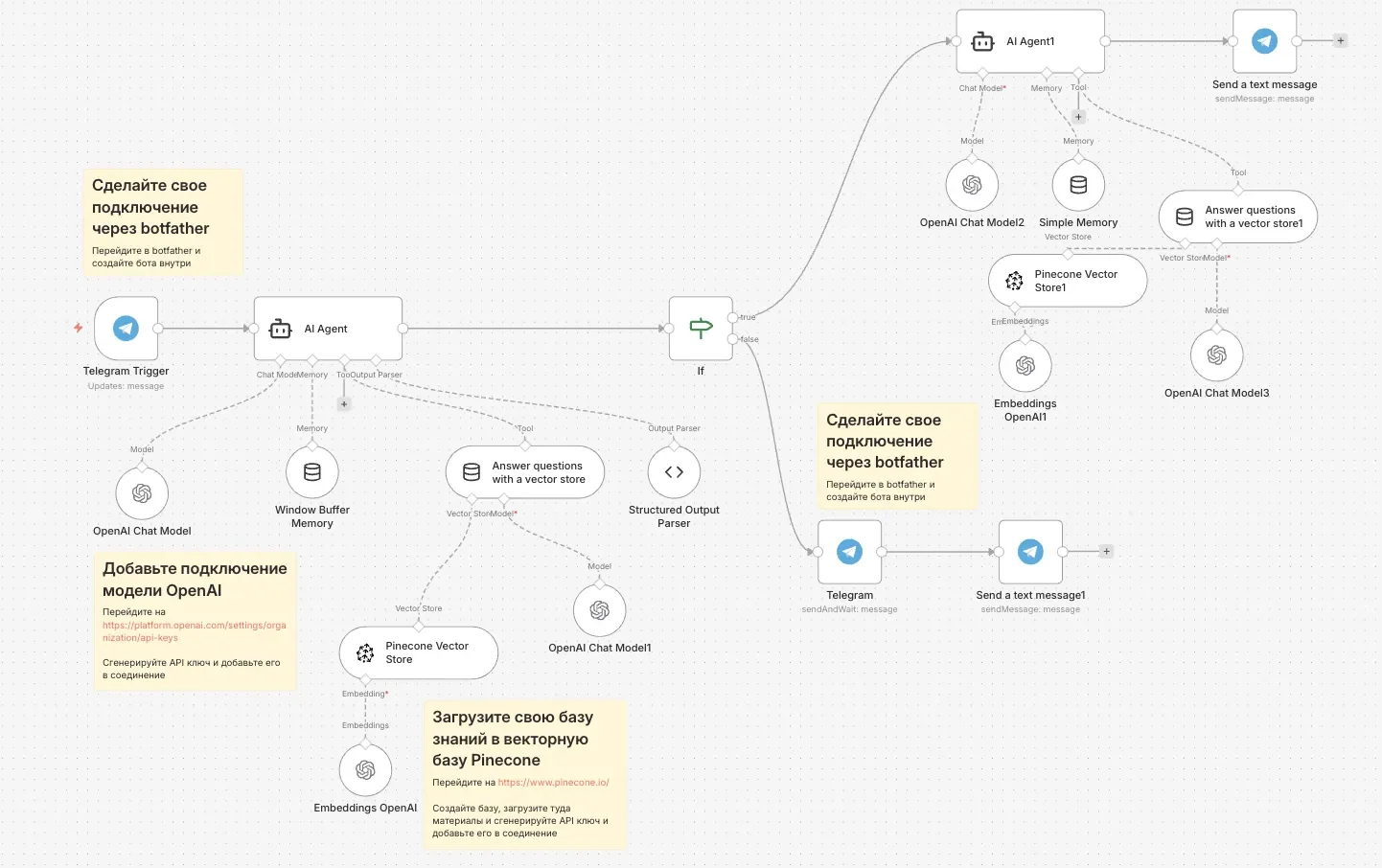
The AI solution: An AI agent connects to all support channels: the website, Telegram,
WhatsApp, and email. It answers routine questions from a knowledge base using RAG. For unusual
requests, it hands over to a support representative with the conversation context. It works 24/7, every day.
Expected result: Up to 75% of inquiries are resolved without a support representative. Average response
time drops from several hours to seconds. Support staff focus on complex cases.
The cost of handling an inquiry falls by 50–70%.
Implementation complexity: ⭐⭐⭐ Medium (requires a structured knowledge base)
How the process works: A customer inquiry arrives through any channel: Telegram, WhatsApp, website widget, or email → the AI agent uses RAG to search the company knowledge base of FAQs, instructions, and policies → if it finds an answer, it replies in natural language → if the question is unusual or the sentiment is negative, it hands over to a support representative with the complete conversation context and a suggested response.
Core components: Telegram/WhatsApp/Email Trigger → AI Agent + RAG (vector database + knowledge base) →
Sentiment Analysis → Routing (automatic reply or escalation to a support representative)
Download the ready-made workflow
💡 Ready to launch an AI agent across your channels?
Contact us by email and we will help build your knowledge base and connect your messaging apps.
CASE 5.2 Feedback analysis and an automatic NPS digest
The challenge: The company collects thousands of reviews each month from Google, marketplaces, the App Store, and post-purchase
surveys. Reading and analyzing everything manually is unrealistic. Patterns go
unnoticed, and problems are not addressed systematically.
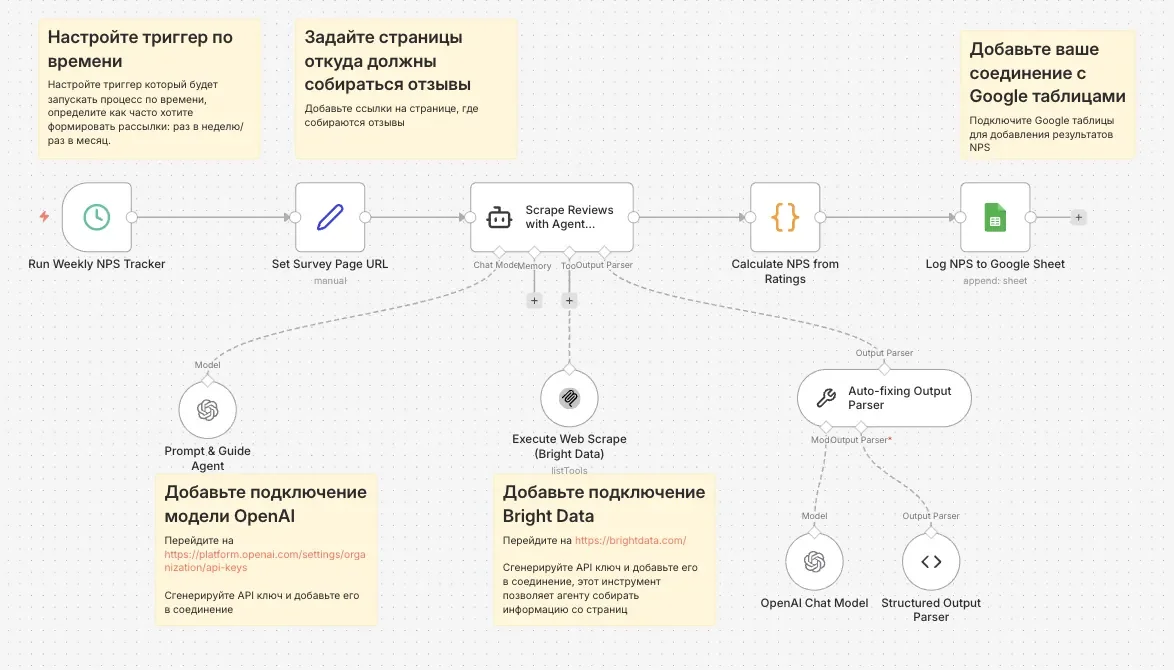
The AI solution: An AI agent collects feedback from all sources daily,
classifies it by topic—product, delivery, service, or price—determines sentiment, identifies
recurring patterns, and prepares a weekly management report with the top 5 problems and
top 5 strengths. Critical reviews are escalated immediately.
Expected result: Management sees systemic problems rather than isolated incidents.
The time from identifying a problem to resolving it falls from months to weeks. NPS begins improving
as a managed metric.
Implementation complexity: ⭐⭐⭐ Medium
How the process works: Every day, the agent collects reviews from connected sources: Google Reviews API,
marketplaces, the App Store, and internal surveys → AI classifies each review by topic—product, delivery, service, or price—and sentiment → a weekly digest is prepared with the top 5 problems, top 5 strengths, and NPS trends → it is delivered to management.
Core components: Schedule Trigger → Google Reviews / Marketplace API / Survey Tool → AI Agent
(classification + sentiment) → Google Sheets / Telegram (weekly digest)
💡 Collecting reviews but struggling to analyze them?
Contact us by email and we will set up automatic feedback collection and analysis.
Additional AI use cases in customer service processes
The following use cases are not provided as ready-made blueprints. Each is implemented in fundamentally different ways depending on the technology stack, data, internal processes, and company maturity. If you would like to implement one, contact us by email and we will explore it for your situation.
Intelligent inquiry routing
AI identifies an inquiry’s topic, urgency, emotional tone, and complexity before it reaches a support representative. It automatically routes the inquiry to a specialist with the right expertise and an appropriate workload.
Real-time suggestions for support representatives
While a representative talks to a customer, AI analyzes the conversation context in a parallel window and provides real-time suggestions: relevant knowledge base articles, similar resolved cases, recommended answers, and warnings about possible risks. The representative selects and adapts information instead of searching for it.
Building a knowledge base from the inquiry archive
AI analyzes the previous 6–12 months of inquiries, identifies the most frequent questions and successful answers, groups them by topic, and generates draft knowledge base articles. An editor reviews and publishes them. The knowledge base stops being a ‘someday’ project and starts updating itself.
Your order
You can pay for the guide in rubles or with a foreign-issued card